BattleTech Faction Color Schemes: Complete Painting Reference

Choosing a faction color scheme is one of the most exciting decisions in the BattleTech hobby. Your paint scheme tells a story—it identifies your force's allegiance, unit history, and personality before a single die is rolled. Whether you're a loyalist painting canonical colors or a mercenary commander designing your own scheme, this guide covers every major faction's official colors with exact paint recommendations.

A word of encouragement: there's no "wrong" way to paint BattleTech miniatures. Canonical schemes are a great starting point, but the universe is big enough for custom mercenary companies, splinter factions, and personal interpretations. Use this guide as inspiration, not law.

[Ad Space - 728x90]

The Great Houses of the Inner Sphere

House Davion — Federated Suns

Primary Colors: Blue and gold/yellow
Character: Noble, militaristic, the "good guys" of the Inner Sphere (at least in their own minds). Davion schemes tend to look clean and professional, befitting a nation that prides itself on military honor.

Standard Scheme: Medium blue armor panels with gold trim and unit insignia. White or cream secondary accents on some units. The Davion Guards regiments use blue with golden sunburst insignia.

Paint Recipe:

  • Base: Vallejo Magic Blue or Citadel Macragge Blue
  • Highlight: Vallejo Electric Blue or Citadel Calgar Blue
  • Accents: Vallejo Glorious Gold or Citadel Retributor Armour
  • Wash: Nuln Oil over blue areas, Agrax Earthshade over gold

Notable Regiments:

  • 1st Davion Guards: Blue with gold accents — the parade regiment
  • Davion Light Guards: Lighter blue with white trim
  • 1st Crucis Lancers: Blue-green with gold, slightly different from standard Davion blue

House Steiner — Lyran Commonwealth

Primary Colors: Blue (darker than Davion) and white
Character: Wealthy, industrial, heavy-metal focused. Steiner is famous for the joke that "Steiner Scout Lances" consist of four Atlas assault 'Mechs. Their schemes reflect industrial might and authority.

Standard Scheme: Dark blue (almost navy) with white accents and the Steiner fist insignia. Some units use royal blue. The darker shade distinguishes them from Davion on the tabletop.

Paint Recipe:

  • Base: Vallejo Ultramarine Blue or Citadel Kantor Blue
  • Highlight: Vallejo Blue or Citadel Alaitoc Blue
  • Accents: White for fist insignia and unit markings
  • Wash: Nuln Oil for deep, dark shadows

Notable Regiments:

  • Royal Guards: Bright royal blue with white — the prestige unit
  • Lyran Regulars: Standard dark blue with minimal accent
  • 10th Lyran Guards: Blue with white stripes — distinctive table presence

House Kurita — Draconis Combine

Primary Colors: Red and black
Character: Japanese-inspired feudal honor, bushido culture, aggressive military doctrine. Kurita schemes are bold and intimidating, reflecting their martial culture.

Standard Scheme: Deep red armor with black secondary panels. Some units use red with white accents. The Kurita dragon insignia is typically in white or gold on a red field.

Paint Recipe:

  • Base: Vallejo Bloody Red or Citadel Mephiston Red
  • Highlight: Vallejo Hot Orange mixed with base or Citadel Evil Sunz Scarlet
  • Secondary: Black for torso sections and joints
  • Wash: Agrax Earthshade over red (warmer), Nuln Oil over black

Notable Regiments:

  • Sword of Light: Bright red with white — Kurita's elite, visually striking
  • Galedon Regulars: Dark red with black — the workhorse regiments
  • Ghost Regiments: White with red accents — reversed scheme, very distinctive

House Liao — Capellan Confederation

Primary Colors: Green and gold
Character: Chinese-inspired, scheming, espionage-focused. The smallest Great House, Liao compensates with cunning and unconventional warfare. Their schemes tend toward darker, more subdued greens.

Paint Recipe:

  • Base: Vallejo Dark Green or Citadel Caliban Green
  • Highlight: Vallejo Goblin Green or Citadel Warpstone Glow
  • Accents: Vallejo Glorious Gold
  • Wash: Agrax Earthshade for warmth, or Nuln Oil for darker look

House Marik — Free Worlds League

Primary Colors: Purple and silver/white
Character: Politically fractious, diverse, the parliament-based democracy of the Inner Sphere. Marik is unique among the Great Houses for its internal divisions, which show in the variety of unit schemes.

Paint Recipe:

  • Base: Vallejo Royal Purple or Citadel Xereus Purple
  • Highlight: Vallejo Warlord Purple or Citadel Genestealer Purple
  • Accents: Metallic silver for trim and eagle insignia
  • Wash: Nuln Oil

The Clans

Clan Wolf

Colors: Brown/tan with red accents
Character: The Crusader Clan most associated with the Inner Sphere invasion. Named for the great wolf of Strana Mechty.

Recipe: Vallejo Beasty Brown base, Agrax Earthshade wash, highlight with Vallejo Khaki. Red accents for unit markings. The earthy scheme is quick to paint and looks great weathered.

Clan Jade Falcon

Colors: Green with gold/bronze trim
Character: Aggressive, traditional, honor-obsessed. Jade Falcon schemes are bold and proud.

Recipe: Vallejo Jade Green or Citadel Warpstone Glow base, gold metallics for trim, Nuln Oil wash. Add jade/teal highlights for a striking look.

Clan Ghost Bear

Colors: Blue and white
Character: Methodical, family-oriented, eventually merged with the Free Rasalhague Republic.

Recipe: Vallejo Electric Blue base, white secondary panels, Nuln Oil wash. The blue-white scheme is clean and distinctive on the table.

Clan Smoke Jaguar

Colors: Grey and black spotted/striped pattern
Character: Brutal and aggressive, destroyed during Operation Bulldog.

Recipe: Vallejo Cold Grey base, stipple or stripe irregular black patches for the jaguar pattern. Nuln Oil wash. This is one of the more challenging schemes but very rewarding.

Mercenary Units

Wolf's Dragoons

Colors: Red and black, similar to Kurita but with their own wolf insignia
Recipe: Vallejo Bloody Red with black panels. One of the most iconic mercenary units in BattleTech.

Gray Death Legion

Colors: Grey with skull insignia
Recipe: Vallejo Cold Grey base, Nuln Oil wash, drybrush Vallejo Stonewall Grey. Simple, fast, and effective—the skull insignia is the star.

Kell Hounds

Colors: Red and black halved scheme
Recipe: Split each 'Mech roughly in half—red on one side, black on the other. Use masking tape for a clean line. Striking and recognizable.

Custom Mercenary Units

This is where BattleTech painting gets really fun. Create your own mercenary company with whatever colors speak to you. Some ideas:

  • Desert camo: Tan, brown, and sand colors for arid world operations
  • Urban camo: Grey, dark grey, and light grey geometric patterns
  • Snow/arctic: White with light blue accents
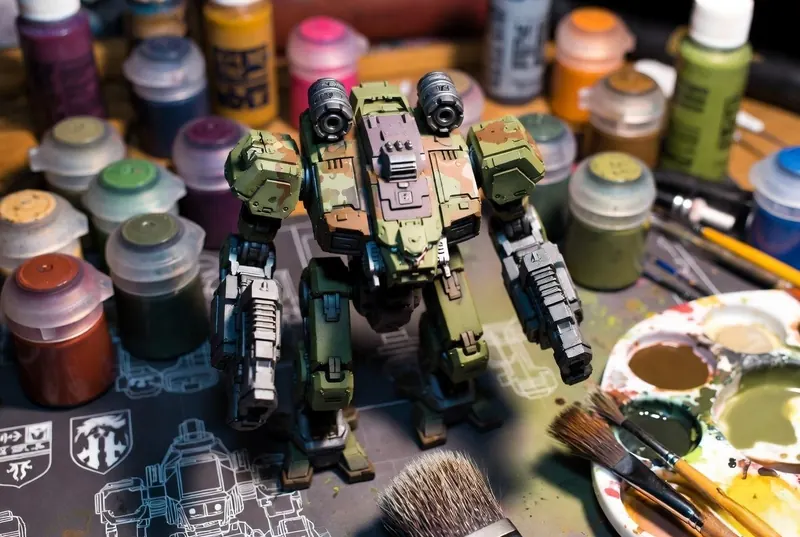
  • Forest camo: Dark green, olive, and brown splotches
  • Pirate/raider: Black with bright red or orange markings

Tips for Painting Faction Schemes

Keeping Colors Consistent Across a Force

The biggest challenge in faction painting is making all your 'Mechs look like they belong together. Tips:

  • Mix enough of your base color to do your entire force in one batch
  • Use the same wash on every model
  • Apply the same basing style to every model
  • Paint in batches rather than one at a time

Adding Unit Markings

Faction insignia and unit numbers elevate a paint job from "colored miniatures" to "military force." Options:

  • Freehand painting: Challenging at BattleTech scale but rewarding. Simple geometric shapes (stripes, chevrons, numbers) are achievable for most painters.
  • Decals: Fighting Pirannha Graphics makes excellent BattleTech-specific waterslide decals for all major factions. Apply with Micro Sol and Micro Set for best results.
  • Skip it: Perfectly acceptable. A unified color scheme identifies your force without individual markings.

🛒 Faction Painting Supplies

Get started painting your chosen faction:

  • Vallejo Game Color or Model Color paints in faction colors (~$12-16 for 3-4 pots)
  • Citadel Shade wash ($8)
  • Fighting Pirannha faction decal sheet (~$8-12)
View Paints on Amazon →

ComStar and Word of Blake

ComStar

Colors: White with red or gold trim
Character: The interstellar communications monopoly that secretly hoarded Star League technology. ComStar forces are elite and well-equipped, and their pristine white schemes reflect their quasi-religious mystique.

Paint Recipe:

  • Base: White primer directly, or Vallejo Off-White/Citadel Corax White
  • Wash: Very diluted Nuln Oil or Agrax Earthshade (50/50 with medium) in panel lines only
  • Accents: Red for ComStar insignia, gold for unit trim
  • Tip: White is challenging—airbrush works best, but careful brushwork with thin layers succeeds

Notable Units:

  • Com Guards: Pure white with red ComGuard insignia—the military arm revealed during the Battle of Tukayyid
  • 1st Division "Invincible": White with gold accents—the most prestigious unit

Word of Blake

Colors: White with black or dark purple accents
Character: The splinter faction that launched the Jihad. More militant than ComStar, their schemes incorporate darker, more ominous accents.

Paint Recipe:

  • Base: White (as ComStar above)
  • Secondary: Black or dark purple for joint sections and weapons
  • Wash: Nuln Oil in panel lines
  • Accents: Purple for Word of Blake symbols

More Iconic Mercenary Units

Northwind Highlanders

Colors: Green and tan tartan pattern (yes, really)
Character: Scottish-themed mercenaries with centuries of tradition. One of the most visually distinctive forces in BattleTech.

Paint Recipe:

  • Base: Vallejo Green-Grey
  • Tartan: Use thin masking tape to create crosshatched lines, then paint alternating dark green and tan stripes
  • Easier method: Paint green base, add irregular tan stripes horizontally, then thin dark green stripes vertically
  • Wash: Agrax Earthshade
  • Note: The full tartan is ambitious—many painters do simplified tartan on one leg or arm only

Eridani Light Horse

Colors: Orange and black
Character: One of the oldest mercenary units, descended from SLDF forces. They maintain strict military traditions and honor codes.

Paint Recipe:

  • Base: Vallejo Orange Fire
  • Secondary: Black for trim and weapon housings
  • Wash: Agrax Earthshade over orange, Nuln Oil over black
  • Highlight: Mix orange with yellow for edge highlights

Blackstone Raiders

Colors: Black with dark red accents
Character: Pirate-affiliated raiders, not reputable mercs. Dark and intimidating scheme perfect for antagonist forces.

Paint Recipe:

  • Base: Black primer, highlight with Vallejo Dark Grey
  • Accents: Vallejo Scarlet Red for weapon barrels, cockpit trim
  • Wash: Nuln Oil
  • Weathering: Heavy chipping and rust effects—these are unkempt machines

Hansen's Roughriders

Colors: Brown and yellow
Character: Rough-and-ready mercenaries specializing in tough contracts. Their schemes look utilitarian and practical.

Paint Recipe:

  • Base: Vallejo Flat Brown
  • Secondary: Vallejo Yellow for unit markings and trim
  • Wash: Agrax Earthshade heavily applied
  • Weathering: Dust and mud effects work perfectly with this scheme

Environmental and Theater-Specific Schemes

Many BattleTech units adapt their colors to the operational theater. Painting your force in environment-specific camo adds battlefield realism and tactical storytelling to your collection.

Desert Camo (Arid Worlds)

Colors: Tan, sand, and dark brown
Application: Sand-colored base with dark brown and lighter tan splotches applied with sponge technique. Dry brush with off-white for dust weathering.

Paint Recipe:

  • Base: Vallejo Desert Yellow
  • Camo spots: Vallejo Flat Brown and Vallejo Ivory sponged on
  • Wash: Agrax Earthshade
  • Weathering: Dry brush Desert Yellow mixed with white on lower legs and feet

Perfect for: Desert planets, planetary invasions on arid worlds, Periphery operations

Forest/Jungle Camo (Temperate Worlds)

Colors: Dark green, olive, brown, and black
Application: Irregular patches in multiple greens create effective woodland camo. This is the classic military camo pattern.

Paint Recipe:

  • Base: Vallejo Olive Green
  • Camo: Vallejo Flat Green, Vallejo Flat Brown, and black sponged in irregular patches
  • Wash: Nuln Oil or Athonian Camoshade
  • Highlight: Dry brush with lighter green on upper surfaces

Perfect for: Heavily forested worlds, jungle planets, guerrilla warfare scenarios

Arctic/Snow Camo (Ice Worlds)

Colors: White, light grey, and pale blue
Application: White base with very light grey and blue patches for ice/shadow effects.

Paint Recipe:

  • Base: White primer
  • Camo: Very light sponging of Vallejo Pale Grey Blue and Vallejo Cold Grey
  • Wash: Extremely diluted Drakenhof Nightshade or Nuln Oil (80% medium, 20% wash) in deepest recesses only
  • Weathering: Use Typhus Corrosion or brown wash on feet/lower legs for snow melt and mud

Perfect for: Arctic operations, ice planets, winter campaigns

Urban Camo (City Fighting)

Colors: Multiple shades of grey with white and black
Application: Angular geometric patterns in varying greys simulate urban ruins and concrete.

Paint Recipe:

  • Base: Vallejo Medium Grey
  • Camo: Use masking tape to create angular shapes, then paint some areas Vallejo Dark Grey and others Vallejo Light Grey
  • Details: Add thin white and black lines for building window/structure details
  • Wash: Nuln Oil

Perfect for: City fighting scenarios, industrial worlds, urban warfare campaigns

Weathering and Battle Damage for Faction Schemes

Clean, parade-ground paint jobs look great, but battle-worn 'Mechs tell a story. Weathering techniques add realism and character without requiring advanced painting skills.

Basic Weathering: Dust and Dirt

The easiest weathering effect that works on every faction scheme:

  1. Mix your base color with dark brown (3:1 ratio)
  2. Thin heavily with water (50/50 paint to water)
  3. Apply to lower legs, feet, and underside of 'Mech torso
  4. Let dry, then dry brush with lighter earth tone

This simulates dirt kicked up during movement. Works on any color scheme and takes 5 minutes per model.

Chipping and Paint Wear

Simulates paint damage from combat and rough terrain:

  1. Use a small piece of sponge dipped in dark grey or metallic silver paint
  2. Lightly dab along edges, corners, and high-wear areas (knee joints, elbows, weapon barrels)
  3. For deeper chips, paint a small dark grey spot, then a smaller silver spot inside it
  4. Don't overdo it—10-15 chips per 'Mech is plenty

Laser Burn Marks

Adds battlefield character and tells a combat story:

  1. Choose 1-2 hit locations per 'Mech (torso, arm, leg)
  2. Paint a black circle/spot where the laser hit
  3. Blend outward from black to dark brown to orange to base color using very thin paints
  4. Optional: Add a small silver dot at the center for the actual breach point

Oil Stains and Leaks

Perfect for mercenary units with limited maintenance budgets:

  1. Use Agrax Earthshade or Seraphim Sepia wash
  2. Apply vertically down from joints, weapon mounts, or torso seams
  3. Let gravity pull the wash downward—don't wipe it away
  4. Creates realistic fluid stain patterns

Era-Specific Painting Considerations

BattleTech spans centuries of warfare, and paint schemes evolved with the timeline. Painting your force to match a specific era adds historical accuracy.

Succession Wars Era (3025-3030)

Characteristics: Heavy weathering, visible damage, patched repairs. This is the dark age of BattleTech—'Mechs are barely maintained and repainted rarely.

Painting approach: Heavy chipping, extensive weathering, oil stains, mismatched repair panels (paint one arm or leg slightly different shade). Less uniform, more ragged.

Clan Invasion Era (3049-3060)

Characteristics: Pristine Clan 'Mechs vs worn Inner Sphere machines. Visual contrast between well-maintained Clan forces and desperate IS defenders.

Painting approach: Clan units should be very clean with minimal weathering—they're new and maintained fanatically. IS units from this era show moderate wear—better than Succession Wars but not pristine.

Jihad Era (3067-3080)

Characteristics: Asymmetric warfare, terrorist tactics, improvised forces. Schemes become more irregular and field-expedient.

Painting approach: Mixed camo patterns, hastily repainted captured 'Mechs, heavy urban camo usage. Perfect excuse for experimental paint schemes.

Dark Age Era (3132+)

Characteristics: HPG network collapse creates isolated regions. Forces become more personalized and localized.

Painting approach: Custom schemes proliferate, less adherence to traditional faction colors, more mercenary-style personalization.

Building a Cohesive Multi-Faction Collection

Many players collect multiple factions for different opponents or scenarios. Keeping your collection organized and visually coherent requires planning:

The Lance-Per-Faction Method

Paint one complete lance (4 'Mechs) per faction. This gives you enough variety to field different forces without overwhelming yourself with painting obligations. Choose 3-4 favorite factions and paint one lance each. You now have 12-16 'Mechs representing different forces for varied gameplay.

Era-Focused Collections

Choose a specific era (Succession Wars, Clan Invasion, etc.) and paint all your forces to match that time period. This creates narrative cohesion—all your 'Mechs exist in the same moment in BattleTech history. Easier to create scenarios and campaigns.

Mercenary Company Approach

Paint your entire collection as a single mercenary company with a unified scheme, but add different accent colors or markings to denote lances. Example: All 'Mechs are grey and black (your merc colors), but Alpha Lance has red accents, Bravo Lance has blue, Charlie Lance has yellow. Unified appearance, easy force organization.

Common Faction Painting Mistakes (And How to Fix Them)

Mistake #1: Colors Too Similar Across Factions

Problem: Davion blue and Steiner blue look identical on the tabletop.
Fix: Exaggerate the difference. Make Davion a brighter, lighter blue and Steiner much darker, almost navy. Opponents need to distinguish forces at a glance.

Mistake #2: Weathering Too Heavy

Problem: Overzealous weathering obscures the faction colors completely.
Fix: Apply weathering to lower 1/3 of the 'Mech only. Keep the torso and arms relatively clean so the faction scheme remains visible.

Mistake #3: Inconsistent Schemes Within a Faction

Problem: Your Kurita force has some 'Mechs in bright red, some in dark red, some with black accents, some without.
Fix: Batch paint your forces. Mix enough base color for all 'Mechs at once, use the same wash throughout, paint all models in a faction together rather than individually.

Mistake #4: White Faction Colors Look Dirty

Problem: ComStar white ends up looking grey or stained.
Fix: Use Off-White (light grey-white) as your base instead of pure white. Pure white has nowhere to highlight to. Off-white can be washed carefully and highlighted back to pure white for a clean finish.

[Ad Space - 728x90]

Related Articles