BattleTech Lore Explained: A Complete Guide to the Universe

BattleTech's lore spans over a thousand years of future history, told across hundreds of novels, sourcebooks, and game supplements. It's one of the deepest, most internally consistent science fiction universes ever created—and it can be completely overwhelming for newcomers. Where do you even start with a timeline that covers the 21st through 32nd centuries?

This guide breaks down BattleTech's history into digestible eras, explains the major factions and conflicts, and gives you enough context to understand what's happening when you sit down to play. Think of it as "BattleTech history for people who want to understand the game, not earn a doctorate."

[Ad Space - 728x90]

The Setting in One Paragraph

Humanity has spread across thousands of star systems but hasn't evolved beyond its worst instincts. Instead of a unified galactic civilization, human space fractured into feudal star empires called the Great Houses, each controlling hundreds of worlds and warring endlessly for supremacy. Giant walking war machines called BattleMechs dominate the battlefield—piloted by individual warriors who are part knight, part fighter pilot, part rock star. After centuries of devastating wars that destroyed much of humanity's technology, a lost branch of humanity called the Clans returns from exile with superior technology and a warrior culture bent on conquering the Inner Sphere. No aliens, no magic, just humans being humans with giant robots.

Era 1: The Age of War and Star League (2005-2781)

Humanity Spreads to the Stars

Beginning in the 21st century, humanity develops faster-than-light travel through the KF Drive (Kearny-Fuchida Drive) and colonizes thousands of star systems. As colonies grow, they form independent nations. Six major powers emerge—the Great Houses—each controlling a region of space called a Successor State. These houses are modeled on real-world empires: House Davion (European chivalry), House Steiner (Germanic industry), House Kurita (Japanese bushido), House Liao (Chinese dynasty), and House Marik (democratic/parliamentary).

The Star League (2571-2781)

The most powerful house, House Cameron, manages to unite all five Successor States under a single government: the Star League. This is the golden age of BattleTech civilization—technology advances rapidly, the economy thrives, and a unified military (the Star League Defense Force, or SLDF) keeps the peace.

BattleMechs are developed during this era, initially as heavy labor machines repurposed for warfare. The Star League represents the peak of human technological achievement—LosTech (lost technology) from this era becomes the holy grail that factions spend centuries trying to recover.

The Fall

The Star League's last leader, Stefan Amaris, stages a coup by murdering the ruling Cameron family and seizing power. General Aleksandr Kerensky, commander of the SLDF, leads a brutal campaign to retake Terra and defeat Amaris. He succeeds—but the Great Houses immediately begin fighting over who should lead the now-leaderless Star League.

Disgusted by their bickering, Kerensky takes the bulk of the SLDF—over 80% of its forces—and leaves known space entirely, disappearing beyond the Periphery in what's known as the Exodus. The power vacuum he leaves behind ignites the Succession Wars.

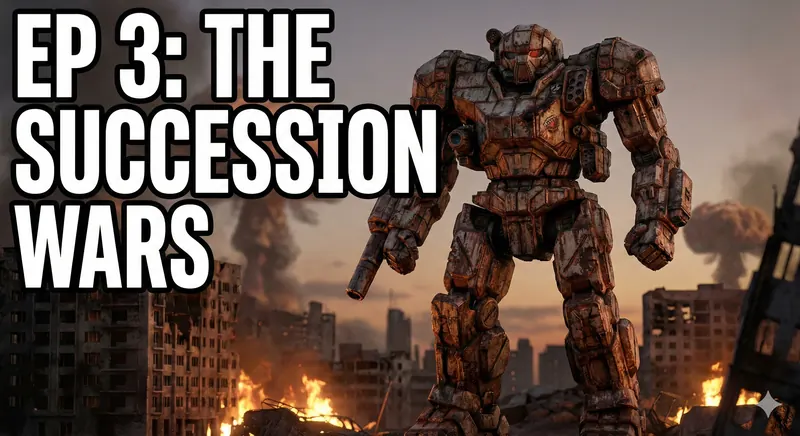
Era 2: The Succession Wars (2781-3049)

With the Star League dissolved and the SLDF gone, the five Great Houses go to war—and keep going for nearly three centuries. The Succession Wars are divided into four phases:

First Succession War (2786-2821)

Total, unrestricted warfare. Nuclear weapons, orbital bombardment, chemical warfare—nothing is off limits. Entire worlds are rendered uninhabitable. Critical factories and research facilities are deliberately destroyed. Billions die. This war doesn't end because anyone wins; it ends because everyone runs out of resources to keep fighting at this intensity.

Second Succession War (2830-2864)

More of the same, but with diminishing returns. The destruction of the First Succession War means there's less industry and fewer advanced weapons available. Technology begins its long decline as the knowledge to build advanced systems is lost along with the factories that produced them.

Third Succession War (2866-3025)

The "default" era for many BattleTech products. By now, the Successor States have exhausted their ability to wage total war. Conflicts become limited, ritualized, almost feudal—small unit actions over contested border worlds rather than campaigns of annihilation. BattleMech combat is the primary method of warfare because 'Mechs are too valuable to risk in all-out bombardment. Technology continues to decline; 'Mechs are maintained with whatever parts can be scavenged or jury-rigged.

This is the era of romantic, desperate warfare—MechWarriors as knights fighting honorable duels while civilization crumbles around them. It's the setting of the original BattleTech game and remains one of the most popular eras for play.

Fourth Succession War (3028-3030)

House Davion and House Steiner form an alliance through marriage (the FedCom alliance) and launch a coordinated assault on House Liao. This short, decisive war demonstrates that the stalemate of the Third Succession War has broken—large-scale offensives are possible again, and the political map is about to change dramatically.

Era 3: The Clan Invasion (3049-3061)

This is the event that changed BattleTech forever. Remember Kerensky and the SLDF that left known space? In the 300 years since the Exodus, they've evolved into the Clans—a warrior society organized into competing bloodlines, bred for combat, with technology far exceeding anything in the Inner Sphere.

The Invasion

In 3049, the Clans return to the Inner Sphere, and the Inner Sphere is not ready. Clan OmniMechs are faster, better-armed, and more heavily armored than their Inner Sphere counterparts. Clan warriors are genetically engineered and trained from birth for combat. Clan tactics, based on honor duels called Trials, are unfamiliar and devastating.

Four Clans lead the invasion: Clan Wolf, Clan Jade Falcon, Clan Ghost Bear, and Clan Smoke Jaguar. They carve through the border states like a hot knife through butter, taking world after world in what seems like an unstoppable advance toward Terra.

The Battle of Tukayyid (3052)

The turning point. ComStar, the quasi-religious organization that controls interstellar communication, challenges the Clans to a proxy battle: if ComStar wins on the planet Tukayyid, the Clans must halt their invasion for 15 years. The Clans accept—their honor system requires it.

ComStar deploys twelve armies against seven Clans on Tukayyid. Through a combination of superior numbers, prepared defensive positions, and understanding of Clan honor-based tactics, ComStar wins decisively. The Clans are forced to honor the truce, giving the Inner Sphere 15 years to adapt and prepare.

The Aftermath

The truce buys time, but the Inner Sphere is permanently changed. Clan technology begins filtering into Inner Sphere forces through captured equipment and reverse engineering. Political alliances shift as the shared threat forces old enemies to cooperate. The Federated Commonwealth fractures under internal pressures, leading to civil war. Meanwhile, the Clans settle into their occupation zones and evolve in unexpected ways—some, like Clan Ghost Bear, begin integrating with the populations they conquered.

Era 4: Civil War and Jihad (3062-3081)

The post-invasion era is marked by internal conflicts. The Federated Commonwealth splits as the Steiner half secedes. A new threat emerges: the Word of Blake, a radical splinter faction of ComStar that launches a devastating interstellar jihad. Nuclear weapons return to the battlefield, HPG networks are disrupted, and the Inner Sphere plunges into chaos.

Operation Bulldog (3059) destroys Clan Smoke Jaguar, proving the Clans can be beaten on their own terms. But the Word of Blake jihad causes damage rivaling the worst Succession Wars.

Era 5: The Dark Age and Beyond (3081-Present)

The post-Jihad era sees the formation of the Republic of the Sphere—a new nation on and around Terra attempting to be a modern Star League. When its HPG network fails, worlds are isolated, old rivalries resurface, and the Successor States resume their eternal conflicts. Clan Wolf eventually conquers Terra, declaring a new Star League under Clan rule—a development that promises new conflicts for decades to come.

Key Factions and Organizations Beyond the Great Houses

ComStar: The Phone Company That Became a Superpower

ComStar controls the hyperpulse generator (HPG) network—the only method of faster-than-light communication in the BattleTech universe. If you want to send a message from one star system to another, you go through ComStar. This monopoly on communication gives them enormous power—they know everyone's secrets, control the flow of information, and can isolate entire regions by denying them HPG access.

ComStar was founded by Jerome Blake, the last Star League communications minister, who took control of the HPG network as the Star League collapsed. What started as an effort to preserve civilization evolved into a techno-religious organization with quasi-mystical beliefs about technology, ritual, and the inevitability of the Star League's return.

For centuries, ComStar maintained neutrality and allowed all factions to use the HPG network—for a fee. But neutrality was a facade: ComStar secretly hoarded Star League technology and built a massive secret military force (the Com Guards) to ensure their position. When the Clans invaded, ComStar revealed its military power by fighting the Battle of Tukayyid and buying the Inner Sphere 15 years of breathing room.

ComStar eventually split into factions: the moderate faction retained the name ComStar, while radicals formed the Word of Blake and launched the Jihad. This civil war within the communications monopoly destabilized the entire Inner Sphere.

The Clans: Warrior Society from Beyond

The Clans are descended from Kerensky's SLDF Exodus fleet. In the centuries after leaving the Inner Sphere, they evolved into a rigid caste system:

  • Warrior Caste: Genetically engineered soldiers bred from the best bloodlines. Warriors compete in Trials for honor, resources, and position. MechWarriors and aerospace pilots occupy the top of the warrior hierarchy.
  • Scientist Caste: Responsible for technology, genetics, and research. They created the warrior breeding program and maintain technological superiority.
  • Merchant Caste: Handle trade, logistics, and economic matters. Considered necessary but low-status.
  • Technician Caste: Maintain equipment, operate infrastructure, and keep Clan society functioning.
  • Laborer Caste: The lowest caste, doing manual labor and menial work.

Clan culture revolves around honor, genetic legacy, and the belief that they must return to the Inner Sphere and restore the Star League under Clan rule. Warfare follows strict protocols: Trials determine outcomes through combat, negotiated bid systems minimize forces deployed (using overwhelming force is dishonorable), and ritual combat between individual warriors decides matters of honor.

Each Clan is named after a totem animal and has distinct traditions. Clan Wolf emphasizes strategic thinking, Clan Jade Falcon values aggression and tradition, Clan Ghost Bear focuses on family and community, and Clan Smoke Jaguar (before its destruction) was notorious for brutality.

Clan technology is visibly superior to Inner Sphere tech: OmniMechs can swap weapon configurations between battles, Clan weapons are lighter and more powerful, and Clan electronics give targeting and coordination advantages that Inner Sphere forces can't match—at least not until they start capturing and reverse-engineering Clan equipment.

The Periphery: Frontier Space

Beyond the borders of the Great Houses lies the Periphery—a vast region of independent worlds, pirate kingdoms, failed colonies, and frontier settlements. The Periphery is where civilization gets thin and life gets hard.

Major Periphery powers include:

  • The Magistracy of Canopus: A hedonistic, culturally liberal state known for entertainment, pleasure industries, and surprising military effectiveness when provoked.
  • The Taurian Concordat: Fiercely independent and paranoid about Inner Sphere imperialism (with good historical reasons). Taurians are tough, self-reliant, and ready to fight to the death against anyone trying to conquer them.
  • The Outworlds Alliance: A loose confederation of worlds that want to be left alone. They maintain minimal military forces and survive through diplomacy and strategic irrelevance.
  • Pirate Kingdoms: Countless small polities run by warlords, pirates, and exiled nobles, constantly raiding each other and occasionally organizing into larger threats.

The Periphery is where you go if you want freedom from the Great Houses' politics—and where you end up if civilization doesn't want you. It's also where lost Star League bases, forgotten colonies, and ancient treasure troves of LosTech sometimes appear, making it a magnet for treasure hunters, mercenaries, and desperate opportunists.

Mercenaries: Guns for Hire

Mercenary units fill a critical role in BattleTech's economy of warfare. The Great Houses can't afford to maintain enough standing military to defend all their borders simultaneously, so they hire mercenaries to supplement their forces. Merc units range from single-lance operations barely scraping by to regiment-strength forces with century-long reputations and sophisticated equipment.

Famous mercenary units include:

  • Wolf's Dragoons: The most prestigious and mysterious merc unit in the Inner Sphere. They appeared in 3005 with advanced equipment and unmatched skills. Later revealed to be a Clan scouting force sent ahead of the invasion—but they decided they preferred the Inner Sphere to Clan life and stayed.
  • Gray Death Legion: Founded by Grayson Carlyle, they became famous for discovering the Helm Memory Core. Their gray-and-skull insignia is iconic.
  • Kell Hounds: Elite merc unit with close ties to House Steiner. Known for their split red-and-black paint scheme and exceptional loyalty to contracts.
  • Northwind Highlanders: Scottish-themed mercenary regiment with centuries of tradition and tartan paint schemes.

Mercenary work is governed by contracts registered with the Mercenary Review and Bonding Commission (MRBC), which enforces payment, arbitrates disputes, and maintains databases of unit reputations. A merc unit's MRBC rating determines what contracts they can secure and what employers will trust them.

Technology: The Machinery That Defines the Setting

BattleMechs: Walking Tanks That Changed Warfare

BattleMechs are 20-100 ton walking war machines powered by fusion reactors and equipped with enough firepower to level city blocks. They combine the mobility of infantry with the firepower of armor, making them the dominant battlefield weapon for centuries.

'Mechs aren't invincible—infantry, tanks, and aerospace fighters all have roles—but they're the most versatile and cost-effective military tool available. A single skilled MechWarrior in a well-maintained 'Mech can hold a position against numerically superior forces, and 'Mechs can operate in environments that would immobilize conventional vehicles.

The iconic nature of BattleMechs in the setting mirrors real-world fascination with tanks, fighters, and battleships—they're the weapons that capture imagination and define their era of warfare.

JumpShips and DropShips: The Logistics of Interstellar War

FTL travel in BattleTech isn't fast or easy. JumpShips use Kearny-Fuchida drives to "jump" between star systems via predetermined points, but they can't land on planets—they're too massive and fragile. DropShips carry cargo, passengers, and 'Mechs from JumpShips in orbit down to planetary surfaces.

This two-tier transportation system creates strategic bottlenecks. JumpShips are expensive and take months to build, so losing one is catastrophic. Controlling a system's jump points means controlling access to that system. Planetary invasions require securing orbital space first, then landing DropShips under hostile fire—a risky, expensive proposition.

The logistics of interstellar warfare limit how fast armies can move and how large forces can be deployed. Conquering planets takes time, resources, and careful planning—there are no surprise FTL jumps directly into enemy capital systems.

Lostech: The Holy Grail

LosTech—Lost Technology—refers to Star League-era equipment that the Succession Wars destroyed the capacity to produce. Double heat sinks, Gauss rifles, advanced targeting computers, certain types of armor—all of this technology existed and was once commonplace, but the knowledge to manufacture it was lost.

LosTech caches are worth more than planets. Entire campaigns revolve around rumors of a lost SLDF base or a forgotten memory core. The discovery of the Helm Memory Core in 3028 allowed the Inner Sphere to begin recovering LosTech production capabilities, marking a turning point in technological capacity.

For players and characters in the setting, LosTech represents the chance to gain decisive advantages—a 'Mech with double heat sinks can fire more frequently, a Gauss rifle outranges most Inner Sphere weapons, and advanced electronics can mean the difference between hitting and missing in combat.

Why BattleTech Lore Works

BattleTech's lore succeeds because it treats its history like real history: messy, contradictory, and driven by flawed humans making decisions with incomplete information. There are no clear "good guys." Every faction has admirable qualities and terrible ones. Wars have consequences that echo for centuries. Technology lost in one conflict takes generations to recover.

For players, the lore provides context that makes games meaningful. You're not just pushing toy robots around a hex map—you're fighting a border skirmish in the Succession Wars, defending against the Clan Invasion, or waging a guerrilla campaign during the Jihad. Every game can be a story.

The best way to explore BattleTech lore is gradually. Start with whatever era you're playing in, read about the factions you're using, and let curiosity guide you deeper. Resources like Sarna.net (the BattleTech wiki) provide exhaustive lore coverage for every era, faction, 'Mech, character, and conflict in the universe.

📚 Dive Deeper Into BattleTech Lore

The best starting novels for BattleTech lore:

  • Decision at Thunder Rift — First BattleTech novel, great introduction
  • Lethal Heritage — Start of the Clan Invasion trilogy
  • The Sword and the Dagger — House Liao political intrigue
View BattleTech Novels on Amazon →
[Ad Space - 728x90]

Related Articles