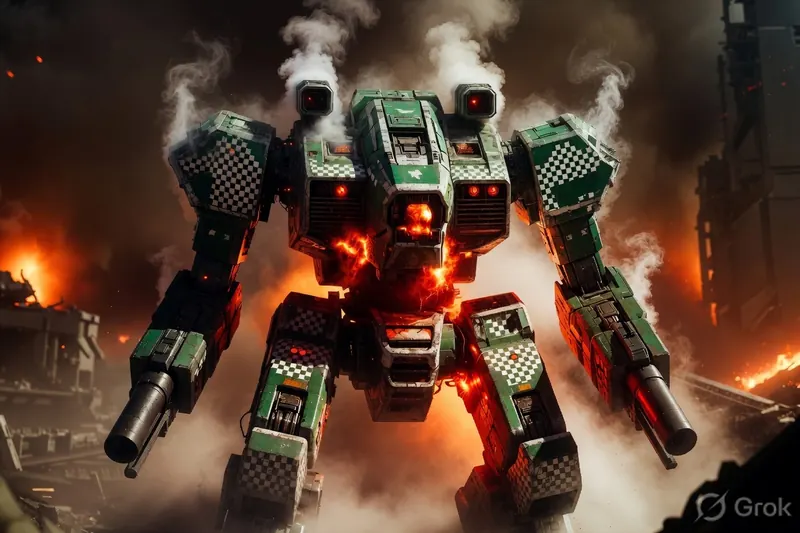
Heat Management in BattleTech: The Mechanic That Changes Everything
Every new BattleTech player learns the same lesson at some point. Usually in their second or third game. They fire everything — PPC, large laser, SRM rack, all of it — their 'Mech overheats, and the next turn they can barely move while their opponent closes in for the kill. The heat system just bit them.
That's not a rules failure. That's the game working exactly as designed. Heat management is the mechanic that makes BattleTech tactically distinctive, and understanding it is the single biggest step between losing consistently and winning consistently.
How Heat Works
Every 'Mech generates heat from weapons fire and movement, and dissipates heat through heat sinks. At the end of each turn you calculate the difference. If you generated more heat than you dissipated, your heat scale climbs. If you generated less, it drops.
The heat scale runs from 0 to 30. As it climbs, things start going wrong:
- At heat 5: movement penalty (-1 to movement points)
- At heat 8: weapons hit penalty (+1 to all to-hit rolls)
- At heat 13: further movement penalty
- At heat 14: risk of ammunition explosion (roll 2D6, on an 8+ an ammo bin cooks off)
- At heat 18: random weapon shutdown
- At heat 22: possible pilot blackout (roll or pilot loses consciousness)
- At heat 26: automatic shutdown
- At heat 30: 'Mech destroyed
Heat sinks dissipate heat — single heat sinks remove 1 point each per turn, double heat sinks remove 2 points each. Most 'Mechs have 10–20 heat sinks. Most energy weapon loadouts can easily generate 20+ heat in a single turn if you fire everything simultaneously.
The Alpha Strike Decision
The term "alpha strike" comes from BattleTech — firing all weapons simultaneously in a single devastating volley. It's the highest-damage option. It's also the highest-heat option, and pilots who alpha strike every turn end up shutting down or losing weapons at the worst possible moments.
The decision isn't "should I fire everything?" The decision is "what can I fire this turn without pushing my heat to a dangerous level?" That calculation — weighing damage output against heat consequences — is what separates effective pilots from ineffective ones.
Common approaches:
- Bracket firing: Alternate between high-heat and low-heat turns. Fire the energy weapons one turn, save them the next and fire ballistics instead.
- Heat budget: Calculate your 'Mech's heat capacity (heat sinks minus expected movement heat) and only fire weapons that fit within it.
- Situational alpha: Save the full alpha strike for the moment when you need to end a threat immediately, accepting the heat consequences because the tactical situation demands it.
Heat by Weapon Type
Different weapons generate different amounts of heat, and understanding this shapes how you use your 'Mech:
| Weapon | Heat Generated | Notes |
|---|---|---|
| Small Laser | 1 | Almost free to fire |
| Medium Laser | 3 | Excellent efficiency |
| Large Laser | 8 | High heat, excellent range |
| PPC | 10 | The classic high-heat weapon |
| ER PPC | 15 | Significant heat cost for extended range |
| AC/5 | 1 | Ballistics are heat-efficient |
| AC/10 | 3 | Still very manageable |
| AC/20 | 7 | High damage, moderate heat |
| LRM-15 | 5 | Missiles are moderate heat |
| SRM-6 | 4 | Good close-range efficiency |
Notice that ballistic and missile weapons are generally more heat-efficient than energy weapons. A 'Mech built around autocannons can fire more freely than one built around PPCs. This is intentional — there are trade-offs between weapon types beyond just damage and range.
Building Around Heat
When you're picking 'Mechs and thinking about lance composition, heat capacity matters as much as weapons loadout. A 'Mech with a good heat sink count that can sustain fire for multiple turns is more reliable than one that can alpha strike once and then becomes ineffective.
Check the heat sink count before you fall in love with a 'Mech's weapons. A Warhammer with 18 heat sinks can fire both PPCs and its other weapons without issue. A 'Mech with 10 heat sinks and a similar loadout will struggle.
What This Looks Like in Play
Good heat management is mostly invisible. You make slightly suboptimal damage choices in early turns to stay cool, and you have the flexibility to apply pressure when it matters. Your opponent, running hot, has to make bad choices — move less, fire fewer weapons, risk a shutdown at a critical moment.
Poor heat management announces itself dramatically. You'll know when you've overdone it because suddenly your movement is limited, your hit rolls are penalised, and you're rolling to see if your ammunition explodes. These are recoverable situations, but they're avoidable ones.
The habit to build is checking your projected heat before you declare weapons fire, not after. It takes ten seconds and it will save your 'Mech more often than you'd expect.