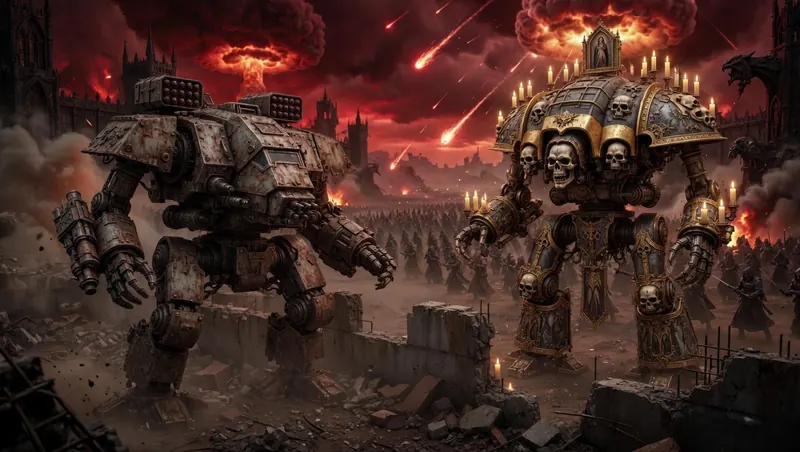
BattleTech vs Warhammer 40K: An Honest Comparison
This is a BattleTech site, so you already know roughly where this is going. But I've put real time into both games and I'm not going to pretend Warhammer is bad — it isn't. They're just very different things, and the right choice genuinely depends on what you want from tabletop gaming.
I've played 40K, Fantasy, Infinity, Star Wars Legion, X-Wing, and Dystopian Wars among others — I'm not going to pretend Warhammer is bad because I know it isn't. Here's an honest comparison from someone who plays both.
Cost
The difference is significant and worth addressing first because it's usually the first question people ask. To get a playable BattleTech force — four 'Mechs, rules, maps — you're looking at $60 for A Game of Armored Combat. To get a tournament-legal Warhammer 40K army you're looking at $400–600 minimum, often more. That's not an exaggeration and it's not cherry-picked. A single Warhammer character model can cost $40–60. BattleTech force packs with four or five 'Mechs run $25–35.
Ongoing costs compound the gap. Warhammer runs on an edition cycle — roughly every three to four years a new edition drops that can invalidate army builds, require new codex purchases, and change the meta substantially. BattleTech's core rules have been stable since the game's inception. A 'Mech that was legal in 1990 plays by the same rules today. Your investment doesn't depreciate.
There's also the painting question. Warhammer has an implicit expectation — not quite a requirement in casual play, but absolutely a requirement at tournaments and strongly felt as a community norm — that models are painted. BattleTech has no such expectation. Grey plastic, cardboard standees, paper printouts — all completely acceptable, including at events. This matters if you're starting out and want to play without committing weeks of painting first.
| Item | BattleTech | Warhammer 40K |
|---|---|---|
| Entry point | $25–60 | $65–170 |
| Playable force | $60–120 | $300–600+ |
| Rules cost | $0–25 (free PDFs available) | $65+ core book required |
| Faction books | Free (record sheets online) | $55 per codex |
| Edition changes | Minimal — rules stable for decades | Major edition every 3–4 years |
| Painting required? | No | Socially expected, required at tournaments |
How the Games Actually Feel
BattleTech is a tactical simulation. A typical game is four to eight units per side, each with a detailed record sheet tracking every weapon, every armour section, and every internal component. When your 'Mech gets hit in the right torso, you mark off the armour. When you fire three PPCs in a turn, your heat climbs and you might have to shut down. Games take two to three hours for four 'Mechs per side. Every decision matters because you're managing a small number of complex objects.
Warhammer 40K is a cinematic spectacle. You field thirty to a hundred-plus models, roll handfuls of dice, and watch squads evaporate in dramatic salvos. The game rewards list-building before the game starts — army composition, faction synergies, strategic trade-offs — and broad tactical decisions during play. Individual model choices matter less because the scale is higher. It's less about managing each unit deeply and more about orchestrating a force.
Neither is objectively better. They're different games for different moods. BattleTech plays like chess. Warhammer plays like a war film.
The Lore Question
Both games have deep lore. Warhammer 40K's setting is grimdark gothic science fantasy — vast, overwhelming, with factions ranging from medieval space knights to fungal alien orks to cosmic horror gods. It's impressive and has spawned an enormous amount of fiction.
BattleTech's universe is narrower and, I'd argue, more coherent. It's human history extrapolated forward: five feudal star empires warring over resources and legacy, a lost golden age being slowly rediscovered, politics and betrayal and the occasional honourable sacrifice. No aliens, no magic. The 40 years of continuous timeline means events in the 3020s have consequences in the 3080s. Characters introduced in early novels reappear as old veterans decades later. The universe rewards investment in a way that sprawling multi-faction grimdark sometimes doesn't.
The Hobby Side
BattleTech models are 6mm scale — small. The detail is good for the size and the mechanical design lends itself to fast painting: prime, basecoat, wash, drybrush, done. You can paint a lance of four 'Mechs in an evening. There are no faces, no cloth, no organic textures to wrestle with.
Warhammer models are larger (28–32mm), more detailed, and expect more from painters. A well-painted Warhammer army is genuinely impressive hobby work. If the painting is the hobby for you — if you enjoy the craft more than the game — Warhammer gives you more to work with.
If you want to game more than you want to paint, BattleTech is the better answer.
Community
Warhammer's community is larger — that's simply the scale of the game. More players, more local groups, more tournament infrastructure, more content creators. The competitive scene is substantial.
BattleTech's community is smaller but genuinely welcoming to new players in a way that large-scale competitive gaming communities sometimes aren't. People want more players. You're not a threat to anyone's ranking when you walk into a BattleTech night at your local game store — you're a reason to play.
Which One Should You Choose?
Choose BattleTech if: you want tactical depth over spectacle, you're cost-conscious, you want rules that don't change underneath you, you like the idea of deep attachment to individual units, or you want to get playing quickly without a painting commitment first.
Choose Warhammer if: you want the large-army cinematic experience, the painting hobby is a core part of the appeal, you want the largest possible competitive and social scene, or you specifically love the 40K setting.
They're not mutually exclusive. A lot of people play both. But if you're deciding where to start with limited time and money, BattleTech is the more accessible, more sustainable entry point.