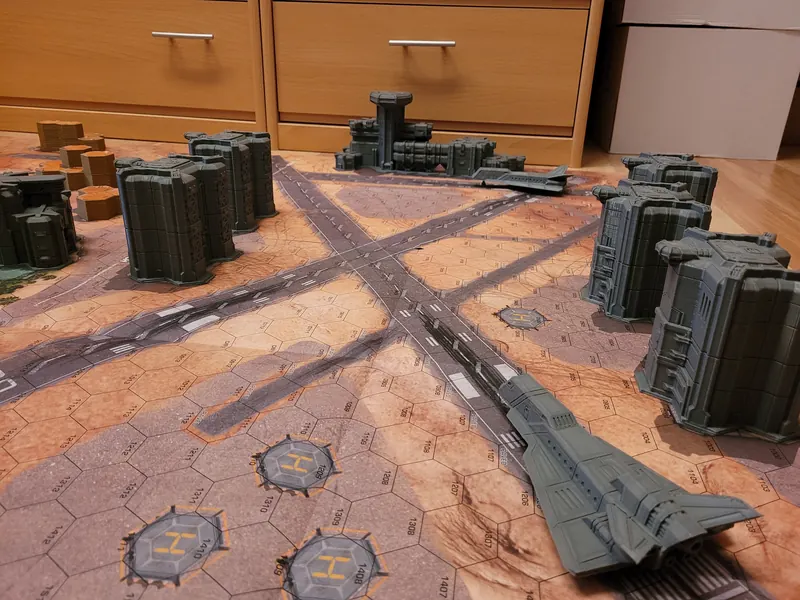
BattleTech Terrain Building on a Budget: Complete DIY Guide
BattleTech's hex maps are perfectly functional for gameplay, but there's something special about playing on a table covered in 3D terrain. Buildings your 'Mechs can hide behind, forests they can crash through, hills that provide elevation bonuses—physical terrain transforms the game from a board game into a miniature wargaming experience.
The problem? Commercial terrain is expensive. A single resin building can cost $20-40, and covering a full table costs hundreds. The solution? Build it yourself. BattleTech terrain is surprisingly easy to make from household materials and cheap craft supplies. This guide shows you how to build an entire table's worth of terrain for under $50.
BattleTech Terrain Basics
Scale Considerations
BattleTech miniatures are approximately 6mm scale (also called 1/285 or 1/300). This means a 'Mech that's 12 meters tall in the game world is about 40-45mm on your table. Buildings should be proportionally sized—a single-story building is roughly 15-20mm tall, a multi-story office block 40-60mm.
The upside of 6mm scale is that terrain is small and quick to build. A building that would take hours in 28mm scale (Warhammer size) takes 20 minutes in BattleTech scale. You can build an entire city in an afternoon.
Hex-Based vs. Free-Form Terrain
BattleTech traditionally uses hex maps, so you have two terrain approaches:
- Hex-based: Build terrain pieces that fit within or across specific hex spaces on your map. More precise for gameplay but requires measuring your hex size.
- Free-form: Build terrain to place on a flat surface, using rulers or estimation for ranges. More visually impressive but requires house rules for terrain boundaries.
Both work great. Hex-based is easier for rules accuracy; free-form is easier to build and more visually dramatic. Many players use a hybrid—hex maps with 3D terrain placed on top.
Essential Materials (Most Are Free or Cheap)
From Your House
- Cardboard: Cereal boxes, shipping boxes, packaging—the foundation of budget terrain
- Styrofoam/polystyrene: Packaging foam, meat trays, insulation board offcuts—perfect for hills and rocky outcrops
- Small boxes: Matchboxes, medication boxes—instant buildings at BattleTech scale
- Textured materials: Corrugated cardboard (roofing texture), window screen mesh (fencing), cocktail sticks (poles/antennas)
- Sand and gravel: From your garden or a local playground—free basing material
Cheap Purchases ($20-30 total)
- PVA glue (white glue): $3-5 per large bottle. Your most-used supply.
- Hot glue gun: $5-10. Essential for fast construction. If you don't own one, this is the single best investment for terrain building.
- Craft paints: $1-2 per bottle at any craft store. Grey, brown, green, black, and white cover most terrain needs.
- Spray paint (optional): $4-6 per can. Grey or black spray paint speeds up painting large terrain pieces enormously.
- XPS foam board (optional): $5-10 per sheet from hardware stores. Excellent for hills, cliffs, and building walls. One sheet makes an entire table's worth of terrain.
Project 1: Basic Buildings (15 minutes each)
Buildings are the most useful BattleTech terrain piece. They block line of sight, provide partial cover, and create interesting tactical choices.
Small Residential Building
- Take a small box (matchbox, medication box, or cut cardboard to ~20x15x15mm)
- Glue the box closed if needed
- Cut a peaked roof from cardboard and glue it on top (or leave flat for an industrial look)
- Score window lines into the cardboard with a pen or hobby knife—no need to cut them out, just impression lines
- Prime grey, paint in building colors, wash with Agrax Earthshade or diluted brown paint
Multi-Story Office Block
- Stack 2-3 small boxes or cut a taller box (~20x15x40mm)
- Score horizontal lines to indicate floor levels
- Score grid patterns on each face for windows
- Add a flat roof with small details (matchstick antennas, cardboard HVAC units)
- Paint grey or tan, pick out windows in dark blue or black, wash for weathering
Industrial Complex
- Use larger boxes or cut foam board into factory-sized rectangles
- Add smokestacks from cocktail sticks or drinking straw sections
- Glue on corrugated cardboard for ribbed metal walls
- Paint in industrial greys and browns with rust weathering (stipple orange-brown paint with a sponge)
💡 Quick City Trick
Build 8-10 basic buildings in one session (about 2 hours). Spray them all grey, drybrush lighter grey, wash with brown. You now have an entire urban combat zone. Arrange them in grid patterns for street fighting scenarios—one of BattleTech's most exciting game types.
Project 2: Hills and Elevation (20 minutes each)
Elevation is a critical tactical element in BattleTech—units on higher ground get attack bonuses. Simple hills make a huge gameplay difference.
Basic Hill
- Cut XPS foam or styrofoam into an irregular oval shape, roughly 80-120mm across
- Bevel the edges with a craft knife at a 45-degree angle for natural slopes
- Optional: Stack a smaller piece on top for a two-level hill
- Coat the entire surface with PVA glue mixed with sand for texture
- Once dry, paint brown, drybrush lighter tan or green, add static grass tufts if desired
Rocky Outcrop
- Break styrofoam into irregular chunks (don't cut—broken edges look like rock)
- Glue chunks together in a natural-looking pile on a cardboard base
- Seal with PVA glue (styrofoam is fragile)
- Paint dark grey, drybrush lighter grey, wash with brown for an earthy look
Project 3: Forests and Vegetation (10 minutes per stand)
Forests provide partial cover and movement penalties in BattleTech. Representing them on a 3D table is easy:
Cheap Forest Method
- Aquarium plants: $3-5 for a bag of plastic aquarium plants from a pet store. Trim them to BattleTech scale (15-25mm tall) and glue to small bases. They're already green and require no painting.
- Dried herbs: Thyme, rosemary, or other dried herbs stuck into a base with hot glue make surprisingly convincing alien vegetation.
- Wire trees: Twist thin wire into tree shapes, coat with PVA, dip in flock or static grass. More work but very realistic results.
- Woodland Scenics clump foliage: $5-8 per bag. Tear off chunks, glue to wire or cocktail stick trunks. The industry standard for miniature trees.
Make forest bases: cut irregular shapes from cardboard or MDF, texture them with sand and paint, then add 3-5 trees per base. The base defines the forest boundary for gameplay purposes, and trees can be removed when 'Mechs move through.
Project 4: Roads and Rivers (30 minutes for a set)
Roads
Cut strips of thin cardboard or felt, 15-20mm wide. Paint grey for asphalt or tan for dirt roads. Add faded center lines with a fine brush for extra detail. Make straight sections, curves, intersections, and T-junctions for a modular road network.
Rivers and Water Features
Cut river sections from cardboard in sinuous shapes, 20-30mm wide. Paint dark blue-green, add lighter blue highlights in the center. For a glossy water effect, coat with PVA glue (dries clear and shiny) or gloss varnish. Add sand along the banks painted in earth tones.
Project 5: Bridges and Special Features (30-45 minutes)
Simple Bridge
- Cut a rectangle of thick cardboard or foam board, wide enough to span your river
- Add side rails from thin cardboard strips or cocktail sticks
- Paint grey with rust weathering (sponge on orange-brown)
- This creates a tactically interesting chokepoint in your games
Communication Tower/Antenna
- Glue cocktail sticks or thin dowels together in a triangular lattice pattern
- Add a platform at the top from cardboard
- Mount on a small base with a "concrete pad" (painted cardboard)
- Great as scenario objectives ("defend the communications relay")
Painting Terrain Fast
Terrain doesn't need the same painting attention as miniatures. Here's the speed method:
- Spray everything with grey or black primer — covers all base construction in one step
- Heavy drybrush in the main color — grey for buildings, brown for natural features, green for vegetation
- Wash everything with diluted brown paint — mix brown craft paint 1:5 with water and slop it over everything. Instant weathering.
- Light drybrush with a pale color — off-white or pale grey on buildings, light tan on earth features. Catches edges and creates highlights.
This four-step process (prime, drybrush, wash, highlight) takes 5-10 minutes per terrain piece once the primer is dry. You can paint an entire table's worth of terrain in a single session.
🛠️ Terrain Building Starter Kit
Everything you need to start building BattleTech terrain:
- Hot glue gun + sticks (~$10)
- XPS foam board sheet (~$5)
- Craft paint set (5-6 colors) (~$8)
- Grey spray primer (~$5)
- PVA glue (~$3)
Total: ~$31 — enough to build terrain for an entire table
View Craft Supplies on Amazon →Complete Terrain Table Budget Breakdown
| Terrain Piece | Quantity | Cost | Time |
|---|---|---|---|
| Buildings (various sizes) | 8-10 | $0-5 (cardboard) | 2-3 hours |
| Hills | 3-4 | $5 (foam) | 1 hour |
| Forest stands | 4-6 | $5-10 (plants) | 1 hour |
| Roads | 6-8 sections | $0 (cardboard) | 30 min |
| River + Bridge | 4-5 sections | $0-2 | 45 min |
| Painting supplies | — | $15-20 | — |
| Total | $25-42 | 6-8 hours |
For the cost of a single commercial resin building, you can build an entire table's worth of terrain. The results might not match studio-quality commercial terrain, but they'll be uniquely yours and perfectly functional for exciting BattleTech games.
Start with buildings (the highest-impact terrain for gameplay), add hills next, then forests. You don't need everything at once—build a few pieces each week and your terrain collection will grow naturally alongside your 'Mech collection.