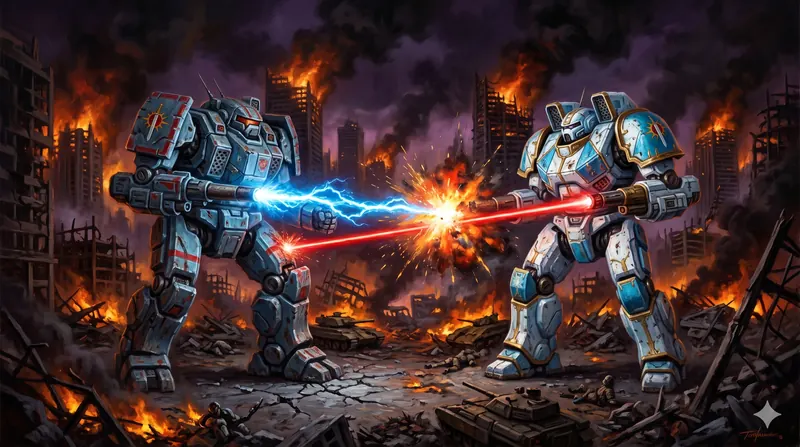
The FedCom Civil War: When the Inner Sphere's Mightiest Alliance Destroyed Itself
For most of its existence, the Federated Commonwealth was the closest thing the post-Star League Inner Sphere had to a superpower. The alliance between House Davion and House Steiner, formalised in 3022 and sealed by the marriage of Hanse Davion and Melissa Steiner in 3028, commanded more worlds, more industrial capacity, and more military strength than any other single entity. It had survived the Fourth Succession War, the War of 3039, and the Clan Invasion. The question of what could destroy it had an answer nobody wanted to hear: itself.
The FedCom Civil War ran from 3062 to 3067. Five years of fighting across a thousand light-years. Millions dead. Two of the most powerful militaries in the Inner Sphere broken against each other. And at the end of it, the Federated Commonwealth was gone — split permanently into the Federated Suns and the Lyran Alliance, poorer and weaker than either had been before the alliance was ever formed.
This is how it happened.
The Marriage of Convenience
The Federated-Commonwealth Alliance Document was signed in secret on 8 May 3022. Both nations kept it quiet for years, partly for security and partly because the political opposition in both realms was vocal. The idea of a Davion-Steiner military alliance was controversial from the start. Senior Lyran commanders feared a FedSuns military takeover. FedSuns officers resented being paired with what they saw as an aristocratic force full of Social Generals who'd never fought a real war.
The Alliance Games of 3026 and 3027 — joint wargame exercises — brought those tensions into the open. The LCAF's embarrassing performance convinced several Lyran senior officers that alliance with the Federated Suns meant eventual absorption. The resentment quietly festered.
When Hanse Davion and Melissa Steiner married on Terra on 20 August 3028, the Inner Sphere genuinely was shocked — not by the marriage itself, which people had begun to suspect, but by what followed immediately. Hanse announced that the Capellan Confederation was his wedding gift to his new wife, and launched the Fourth Succession War on the same day. Whatever anyone thought of the alliance, it worked. Over the next three years the combined Federated Commonwealth took 107 worlds from House Liao and 51 more from the Draconis Combine. The mathematical stalemate of the Third Succession War was over.
The AFFC — the Armed Forces of the Federated Commonwealth — was formally created on 1 April 3042, merging the AFFS and LCAF under a unified command structure. New uniforms, new rank structures, new chain of command. Almost immediately, it became a source of grievance rather than pride. FedSuns officers found themselves surrounded by Lyran counterparts they didn't respect tactically; Lyran officers felt outnumbered and sidelined. The AFFC was, as one general put it, an organisation wrought with problems — and it was a decade before it faced a real enemy.
The Clan War and Its Costs
The Clan Invasion of 3050 hit the AFFC from a position of institutional dysfunction. The Clans tore through Lyran space first, and the AFFC response was exactly the kind of command failure its critics had predicted: units poured into the path of the invaders with no coordinated strategy, and the early battles were disasters. Too many young soldiers died proving what the generals should already have known — that the AFFC needed to fight smarter, not just harder.
ComStar's Com Guards stopped the invasion at Tukayyid in 3052, buying a fifteen-year truce. The cost was enormous. The Clan War had ravaged dozens of worlds, shattered the AFFC's JumpShip logistics, and killed Prince Hanse Davion — who died of a heart attack shortly after the Truce, leaving the Federated Commonwealth without its most capable leader at its most vulnerable moment.
Archon Melissa Steiner-Davion stepped into the gap and for three years held the alliance together almost single-handedly. She was genuinely beloved on both sides of the border. Her death on 19 June 3055, killed by an assassin's bomb on Tharkad, shattered that. Victor Ian Steiner-Davion became Archon-Prince on the same day, ruler of a nation destined to tear itself apart.
Two Siblings, Two Nations
Victor and Katherine Steiner-Davion were always going to be in conflict. Where their father was a strategist and their mother a diplomat, Victor was a soldier — brilliant in the cockpit, uncertain at the palace. Katherine, by her eighteenth birthday, had mastered the arts of manipulation their mother had hoped she would never need. She inherited Melissa's beauty and the Davion hunger for power.
From the moment Melissa died, rumours swirled that Victor was complicit in the assassination. History would later indicate that one of Katherine's own people was involved in the plot. But in 3055, the rumours were enough to do damage, and Katherine's people worked carefully to keep them alive.
Victor's biggest mistake wasn't political — it was the Joshua Marik incident. In 3057, learning that the young son of Captain-General Thomas Marik was dying of leukemia, Victor withheld that information from Marik and replaced the child with a double, to maintain the Free Worlds League's military support for the AFFC during the Clan threat. When Marik discovered the deception, he immediately launched Operation Guerrero against the Federated Commonwealth, and Chancellor Sun-Tzu Liao joined the assault. The worlds lost in that campaign became the Chaos March, a permanent scar on the Federated Suns' coreward border.
While Victor was absent in Clan space on Operation Serpent in 3058 and 3059 — the task force sent to destroy the Smoke Jaguar homeworld — Katherine seized the Lyran half of the Federated Commonwealth. She named herself Archon Katrina (in memory of her grandmother, she said, though few missed the political calculation), and from her palace on Tharkad, manipulated the citizens of both realms with a PR operation of extraordinary scope. Her secret police suppressed protests. Her appointees displaced capable officers throughout the AFFC chain of command. By the time Victor returned from Clan space having won one of the greatest military victories in Inner Sphere history, he came home to a nation that barely recognised him.
The first shot: Fighting first broke out on Solaris VII in August 3062 — a championship match between a Lyran and FedSuns champion that turned into a full-scale brawl. The violence spread off-world. On 16 November 3062, tensions on Kathil came to a head when the Eighth FedCom RCT and the newly-constituted Kathil CMM came to blows. Within a week, fighting had broken out on a dozen more worlds. The Civil War had begun.
The Seven Waves
The FedCom Civil War is documented in seven operational waves, though the fighting didn't stop neatly between them. The structure reflects the shifting strategic situation rather than distinct ceasefire periods.
Wave One (November 3062–August 3063) was less a military campaign than a street brawl on an interstellar scale. Most commanders on both sides had no orders, no plan, and no clear understanding of which units stood where. Field Marshal Ardan Sortek — returned to rank by Victor — spent Wave One quietly building a logistics network within the Federated Suns, contacting officers he trusted, and guaranteeing that those who refused Katherine's illegal orders could keep fighting. Without Sortek's groundwork, the Allied cause might have collapsed before it organised. Katharine meanwhile moved her most trusted units into strategic positions and had her loyalists installed at key command levels throughout the AFFC.
Wave Two (March–August 3063) saw the war develop into something recognisable as military strategy, though still largely a contest of wits between the AFFS's two most senior officers — Sortek and Jackson Davion on the Allied side, Simon Gallagher directing the Loyalists on Katherine's behalf. Kathil remained the war's central industrial prize, contested bitterly as both sides recognised that whoever controlled its shipyards and 'Mech production facilities controlled the long-term logistics of the war.
Wave Three (September 3063–April 3064) spread the conflict across both realms simultaneously. Victor, still operating from the Lyran Alliance's periphery, began a high-mobility campaign that took him to York and then scattered his units across a dozen worlds in coordinated strikes. His plan was devastatingly effective tactically — LAAF forces couldn't track every Allied move — but Clan Jade Falcon's invasion of the Lyran Alliance in February 3064 threatened to end the war by destroying both sides' northern flank before they finished fighting each other.
The Jade Falcon Incursion (3064–3065) was the war's critical interruption. Khan Marthe Pryde led a ferocious campaign that took thirteen worlds from the Lyran Alliance while the LAAF was undermanned and distracted. What saved the Alliance — and arguably the entire Civil War's outcome — was General Adam Steiner, a Lyran officer who had no strong political affiliations. He rallied the available LAAF forces, won a string of victories against the Falcons, and rebuilt Lyran morale sufficiently that the nation held. When the Incursion ended, Adam Steiner commanded the loyalty of billions of Lyran citizens regardless of their Civil War allegiances — something that would matter enormously in Wave Seven.
Waves Five and Six (3065–3066) saw the Federated Suns grinding toward the endgame. The death toll was in the millions, with civilians accounting for the great majority — not from deliberate targeting but from the collateral destruction of fighting on inhabited worlds and the economic paralysis that the war imposed on dozens of agricultural and industrial systems. Katherine's agents were still suppressing opposition ruthlessly, but even her most committed supporters were beginning to question the cost. Meanwhile Victor, despite a succession of tactical victories, could never quite translate them into the knockout blow Katherine's position required.
Wave Seven (November 3066–April 3067) was New Avalon. Everything had been building to this.
The Battle for New Avalon
Victor arrived in the New Avalon system on 8 November 3066 at the head of a virtual armada — the FCS Melissa Davion and four Fox-class corvettes against Katherine's two Loyalist Fox-class ships. The WarShip battle that followed was the largest fought in the Inner Sphere since the First Succession War. It lasted less than an hour and ended with two Loyalist ships surrendering and significant damage across the fleet. Victor grounded that day on Brunswick continent with the Twenty-Third Arcturan Guards, Sixth Crucis Lancers, Tenth Lyran Guards, First NAIS Cadre, Outland Legion, and a battalion of First St. Ives Lancers.
Katherine called on New Avalon's population to resist in any way they could. The world was genuinely loyal to the Davion family — she had too many enforcers and not enough goodwill to make that appeal work. Still, the fighting was bitter. The Loyalists held the continent of Albion for months with the Nineteenth Arcturan Guards and the Remagen CMM. The Tenth Davion Light Guards delivered a flanking attack on the Allied right that broke two RCTs and bought Katherine's defenders six weeks. Jackson Davion — Marshal of the Armies, one of the most respected officers in the AFFS — stepped down on 28 March, creating a command vacuum that no one could fill.
It wasn't enough. On 20 April 3067, Katherine Steiner-Davion issued her surrender to Victor Steiner-Davion.
The Aftermath
Victor didn't prosecute the war to claim a throne. He renounced all claim to the throne on both New Avalon and Tharkad, stripped his sister Katherine of her rights and titles, and banished her to servitude within the Clan Wolf Occupation Zone as punishment for her crimes. His brother Peter took the Archonship of the Lyran Alliance. On New Avalon, Duchess Yvonne Steiner-Davion assumed the Regency in Victor's absence, with Victor accepting appointment as Precentor Martial of ComStar.
The Federated Commonwealth was over. It had been over since Katherine's secession in 3057, but now it was formally, permanently finished. What remained were two nations — the Federated Suns and the Lyran Alliance — that shared history, shared trauma, and shared the task of rebuilding militaries shattered against each other.
The cost was staggering. The Civil War killed more people than the nuclear firestorms of the First Succession War, though over a longer period and more distributed geography. Dozens of worlds had their economies crushed. The AFFC, once the most powerful military force in the Inner Sphere, was broken into two weakened halves whose officer corps were scarred by five years of killing people they had trained alongside. Tens of thousands of military personnel who had committed no greater crime than following lawful orders spent years under investigation. The general amnesty that Victor and Yvonne declared was necessary and still inadequate.
The real winner: Sun-Tzu Liao. While Victor and Katherine's forces ground each other down across a thousand worlds, the Capellan Chancellor quietly rebuilt his nation's military and political position, absorbing the Chaos March worlds that the Civil War had left ungoverned. He hadn't fired a shot in the Civil War. He didn't need to.
The long-term damage extended beyond the military and the body count. The Civil War had demonstrated that the Inner Sphere's greatest alliance was more fragile than anyone had understood. It had demonstrated that a single political actor, sufficiently ruthless and sufficiently patient, could fracture an institution that had survived Clan invasion, Succession War, and centuries of external pressure. And it had happened at the worst possible moment — with the Word of Blake's Jihad beginning to stir in the shadows, the Inner Sphere emerged from the most destructive internal conflict since the Second Succession War bloodied, exhausted, and fundamentally weakened.
The Jihad was already beginning. The Inner Sphere had no idea.
Continue Reading: The Clan Invasion · The Jihad · The Succession Wars · The Five Great Houses